 Apr 28, 2026
The Real Cost of a Hot Classroom: How Poor Building Envelope Specification Affects Learning Outcomes and Energy Bills
Indian education institutions face a highly competitive market, where school success is defined by their IT infrastructure and academic content. However, a critical performance metric remains invisible: the “thermal health” of the classroom. At Mount Roofing and Structures, we have observed that many educational facilities suffer from a “performance gap” where the building shell,the roof and walls,fails to manage heat gain. This isn’t just a comfort issue; it is a structural failure that drains institutional budgets and hinders the cognitive development of students.
When a school building is specified with traditional masonry or uninsulated metal sheets, it essentially becomes a massive thermal battery, absorbing solar radiation all day and radiating it inward.
The Cognitive Toll: Why “Hot” Means “Slow”
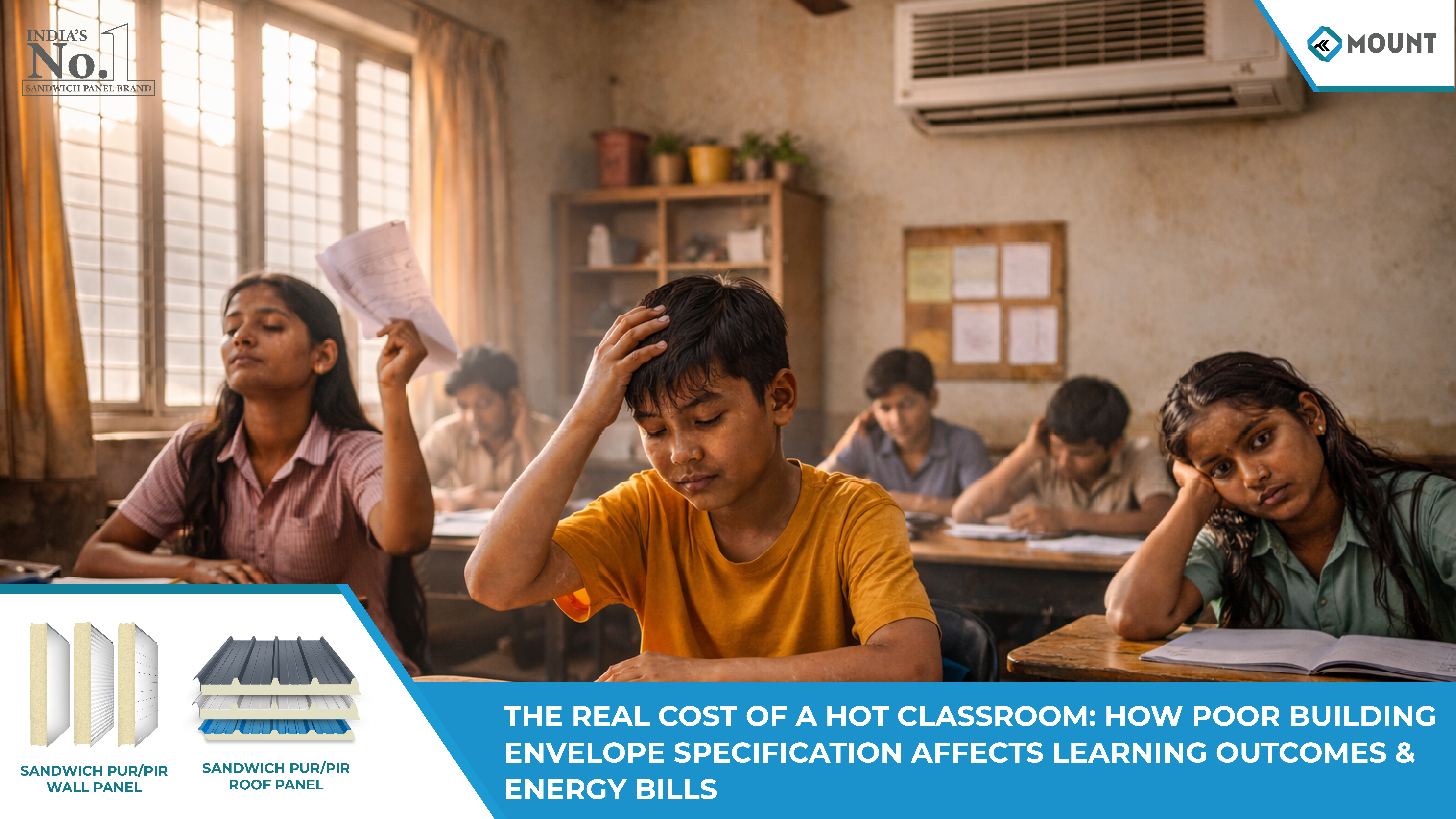
There is a direct relationship between ambient temperature and academic performance, which can be quantified. Studies have shown that student concentration levels as well as memory retention start to decline significantly as indoor temperatures rise above 26 degrees centigrade. In most parts of India, classrooms without a strong building envelope can rise to 34 degrees centigrade during peak hours. At this point, the brain is distracted from learning to cool down the body.
By specifying insulated panels in schools, administrators are not just ordering building materials; they are also investing in student concentration levels. A stable building envelope ensures that the ‘noise’ of physical discomfort is completely eliminated, allowing for greater teacher productivity.
The Energy Drain: Financing the Heat
For most schools, the electricity bill is one of the highest recurring operational costs. Traditional construction with high thermal conductivity forces a heavy reliance on HVAC systems. Every degree of heat that leaks through an uninsulated roof adds a literal cost to the institution’s balance sheet.
Developing energy efficient school buildings requires a shift from active cooling (AC units) to passive thermal resistance. A high-quality sandwich panel system acts as a thermal break, significantly reducing the “cooling load” required to maintain a comfortable environment. When the building envelope is “tight” and well-insulated, HVAC systems run less frequently and last longer, providing a double-saving effect on both utility bills and maintenance capital.
The Engineering of a Superior Envelope
Achieving a thermally intelligent campus requires specific school building insulation solutions. As a leading sandwich panel manufacturer, we advocate for integrated systems that address heat, sound, and safety simultaneously.
- Roofing Logic: Since the roof is the primary target for solar radiation, using sandwich panels for roofing is the most effective way to block overhead heat. These panels utilize a core that prevents the “radiant heater” effect common in standard sheds.
- Wall Integrity: Sandwich panels for walls offer a slim profile with superior U-values (thermal transmittance). Unlike thick brick walls that store heat and release it slowly at night, these panels provide immediate thermal protection.
- Compliance and Safety: In a school environment, safety is non-negotiable. Specifying Fire Rated Sandwich Panels ensures that the building meets the highest fire-safety standards (NBC compliance) while maintaining thermal efficiency.
Why Industry Leaders Partner with Mount
At Mount Roofing and Structures, we don’t just supply products; we engineer institutional environments. We understand that educational projects operate on strict timelines,often needing to be completed during summer or winter breaks. Our sandwich panel systems allow for “dry construction,” which is up to three times faster than traditional methods, ensuring your campus expansion is ready before the new term begins.
Choosing Mount means opting for a technical partner that understands the nuances of the Indian climate. Our panels are tested for extreme heat and high humidity, ensuring that your investment in sandwich panels for walls and roofing remains a high-performing asset for decades.
FAQ
- How does the thermal resistance of a sandwich panel compare to a traditional 9-inch brick wall? A 50mm PUF or Rockwool sandwich panel can offer up to four times the thermal resistance of a standard brick wall. This allows institutions to achieve better cooling with significantly thinner walls, effectively increasing the usable carpet area of the classrooms.
- Can we retrofit an existing school building with these insulation solutions? Yes. Retrofitting is a common request. We often install sandwich panels for roofing directly over existing aging structures. This immediately lowers indoor temperatures and provides a permanent waterproofing solution, extending the life of the building.
- Do insulated panels help with the noise from rain and wind during the monsoon? Absolutely. The core material in a sandwich panel acts as a vibration dampener. This eliminates the “drumming” sound of rain on metal roofs, which is a major distraction in classrooms during the Indian monsoon season.
- What is the lifespan of Mount’s sandwich panels in a high-traffic school environment? Our panels are manufactured with high-tensile, pre-painted galvanized steel. They are resistant to corrosion, mold, and physical impact. With minimal cleaning, these systems typically have a functional lifespan of 25–30 years.
5. Are Fire Rated Sandwich Panels necessary for single-story school buildings? While fire load requirements vary, using Fire Rated Sandwich Panels (specifically with Mineral Wool cores) is a best-practice for any assembly building. It ensures that in the event of an electrical fire, the envelope does not contribute to the spread of flame or toxic smoke.
Similar Events
 23 October, 2026