 Sep 1, 2026
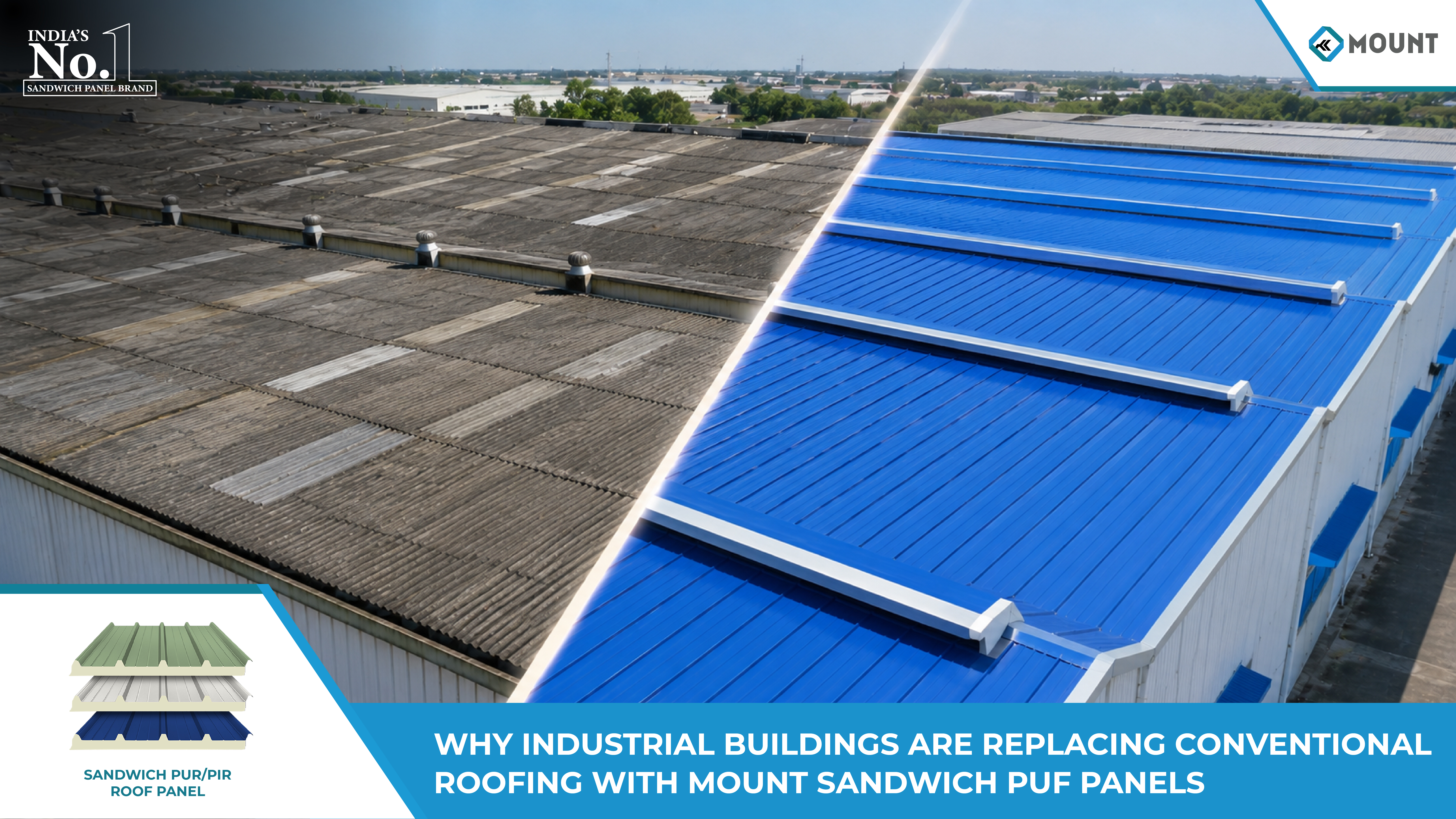
Why Industrial Buildings Are Replacing Conventional Roofing with Mount Sandwich PUF Panels
Industrial roofing has moved beyond being a basic weather barrier. For warehouses, manufacturing plants, logistics facilities and large-span industrial buildings, the roof now has a direct role in controlling heat gain, protecting materials, maintaining working conditions and managing building energy requirements. This is one reason industrial roofing panels are increasingly being considered during the early stages of building design rather than treated as a finishing element.
The shift does not mean conventional roofing has no place. The choice depends on the building’s location, usage, span, thermal requirements and project budget. However, where the building needs better insulation, faster enclosure and more predictable indoor conditions, an insulated roof system can address several requirements within one engineered assembly. For project owners and EPC contractors, that combination can influence both construction planning and long-term operating performance.
Why Thermal Performance Is Becoming a Roofing Priority
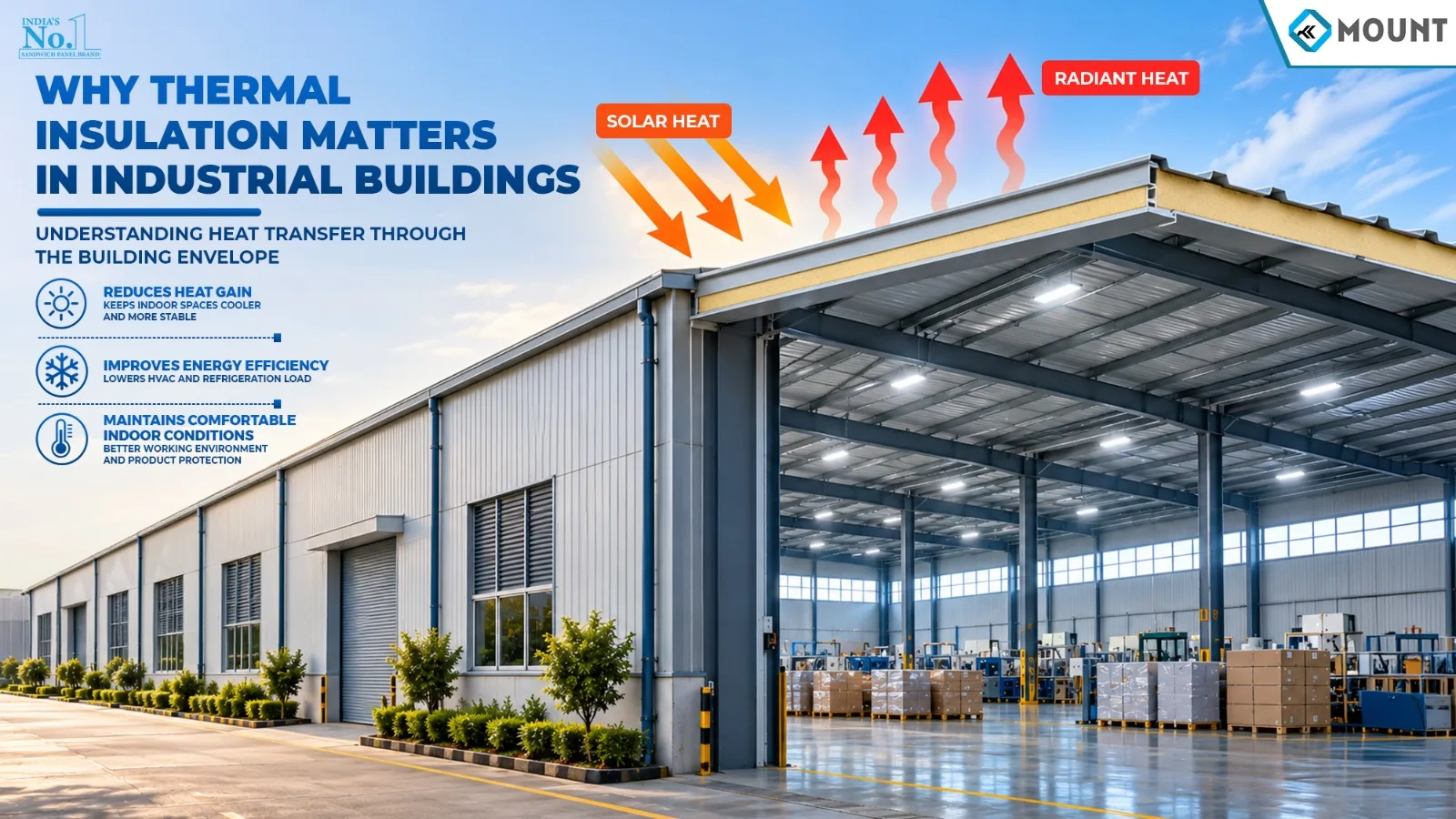
Large industrial buildings have extensive roof areas exposed to solar radiation throughout the day. Without an adequate insulation layer, a significant amount of heat can be transferred through the roof into the occupied space. The result can be higher cooling requirements, greater HVAC loading and less consistent internal temperatures.
This is where industrial PUF panels become relevant. Rigid polyurethane foam has a closed-cell structure and relatively low thermal conductivity, allowing the panel to provide an insulation layer between the external and internal metal facings. Mount’s PUF panels are manufactured with a controlled core density of 38–42 kg/m³, with thermal conductivity specified in the range of 0.022–0.028 W/m·K.
For facilities operating large HVAC systems, temperature-sensitive processes or heat-intensive equipment, reducing uncontrolled heat transfer through the building envelope can be an important part of the overall energy strategy. The correct panel thickness, roof geometry, joint detailing and installation quality all need to be considered together rather than selecting insulation purely by thickness.
Faster Enclosure Without Adding Separate Insulation Layers
Construction schedules are increasingly measured in weeks and days, particularly for warehouses, logistics parks and manufacturing facilities where operations need to begin quickly. A roofing system that combines the external skin, insulation core and internal finish into a factory-manufactured component can simplify site execution.
Roofing sheets for industrial buildings traditionally involve several coordinated activities when insulation and internal lining are specified separately. Insulated sandwich construction consolidates these functions into a prefabricated panel. Panels arrive at site ready for positioning and fixing, reducing the number of individual layers that need to be installed overhead.
Mount manufactures its sandwich panels through a continuous panel manufacturing line, where the rigid PUF core is bonded between pre-painted steel facings under controlled production conditions. The available PUF thickness range is 30 mm to 200 mm, allowing panel selection to be matched to project requirements rather than using one standard configuration for every building.
Moisture Protection Depends on More Than the Panel
Rainwater management is another critical consideration for industrial roofs. Panel selection alone does not create a weather-tight building envelope. Roof slope, flashing, penetrations, fasteners, overlaps or interlocking joints, sealants and installation workmanship all influence the final result.
For this reason, PUF Sandwich Roofing Panel systems need to be detailed as complete roof assemblies. Mount offers cam-lock and tongue-and-groove jointing configurations, allowing the joint system to be selected according to the panel application and project detailing requirements.
A properly designed and installed insulated roof can also reduce the need for repeated intervention associated with deteriorated insulation layers or exposed internal insulation. Maintenance requirements still depend on the steel facing, coating specification, environment, drainage design and installation quality, particularly in coastal or chemically aggressive industrial locations.
Why Panel Construction Matters in Large Industrial Buildings
A sandwich panel is more than two metal sheets with insulation placed between them. The facings and core work as a composite section, giving the panel stiffness while the core provides thermal resistance. In roof applications, the external profile also contributes to the panel’s structural behaviour.
For large facilities, this combination can help simplify the building envelope because the roof panel performs multiple functions within one manufactured component. Mount’s technical documentation specifies PUF panels from 30 mm to 200 mm, with core density controlled between 38–42 kg/m³. The roof panels can be supplied with profiled external faces, while joint configurations support continuity between adjacent panels.
This becomes particularly relevant in warehouse insulation panels, where the building may have a large roof area, high internal volume and substantial heat exposure. The objective is not simply to install an insulated product, but to create an envelope whose thermal and weather-related characteristics are considered alongside the structural and operational requirements of the facility.
Mount’s Manufacturing Scale Supports Large Project Requirements
For industrial projects, product performance and supply capability have to work together. A technically suitable roofing specification has limited value if production capacity, quality consistency or delivery coordination cannot support the project schedule.
Mount operates continuous panel manufacturing infrastructure with a stated sandwich-panel production capacity of up to 7,00,000 square metres per month across its panel manufacturing operations. Its PUF panels are produced using controlled core density and dimensional parameters, with available facing options including pre-painted GI, Galvalume and stainless-steel grades.
For an industrial roofing panels manufacturer, this production scale matters particularly when a project requires substantial quantities within a defined construction window. Mount’s integrated manufacturing model also brings PEB structures, insulated panels, roofing products and related building-envelope components within the same manufacturing ecosystem, supporting coordinated procurement and project execution.
A Roof System Designed Around the Building
The move toward insulated industrial roofing is ultimately about treating the roof as part of the building’s performance strategy. Thermal requirements, operating conditions, roof geometry, drainage, joint detailing, structural design and installation sequencing need to be considered before material selection is finalised.
Mount approaches this requirement from a manufacturing and building-envelope perspective. Its PUF range serves industrial warehouses, logistics facilities, manufacturing environments, food and beverage facilities, poultry and dairy applications, and other industrial buildings.
For project teams evaluating PUF Panels for Industrial Roofing, the advantage is therefore not simply insulation. It is the ability to specify a factory-manufactured roof component around defined thermal, structural, dimensional and project-scheduling requirements.
Why Choose Mount for Industrial Roofing?
Mount brings product manufacturing, technical specification and project-scale supply together rather than treating roofing as an isolated material purchase. Its continuous panel manufacturing capability, controlled PUF core parameters, broad thickness range and integrated building-product portfolio provide EPC contractors, developers and industrial project owners with a more coordinated route to building-envelope execution.
For projects where roof performance, installation timelines and supply certainty have to align, the right approach starts with engineering the roofing system around the building’s actual requirements. Mount Roofing & Structures provides the manufacturing capability and technical product range to support that decision from specification through project execution.
Frequently Asked Questions
Q. How should PUF roof panel thickness be selected for an industrial building?
A. Thickness should be selected based on the building’s thermal requirement, internal operating conditions, climate, HVAC strategy, roof configuration and project-specific design criteria. A thicker panel is not automatically the correct specification for every industrial facility.
Q. Do PUF panels eliminate the need for separate roof insulation?
A. A sandwich PUF roof panel integrates the insulation core with the external and internal facings, so a separate insulation layer may not be required for applications designed around the panel system. The final assembly should still be evaluated against the project’s thermal and regulatory requirements.
Q. How important are panel joints in industrial roofing?
A. Joint detailing is critical. Interlocking geometry, sealants, fasteners, flashings and installation accuracy all contribute to weather resistance and continuity of the building envelope. Mount offers cam-lock and tongue-and-groove jointing options depending on panel configuration.
Q. Can PUF sandwich panels be used for large warehouse roofs?
A. Yes. PUF sandwich panels are used for industrial warehouses and logistics facilities, provided the panel specification, structural support spacing, loading conditions, roof slope and fixing system are engineered appropriately. Mount’s range is available from 30 mm to 200 mm thickness.
Q. What should an EPC contractor evaluate when selecting a PUF panel manufacturer?
A. Beyond price, the evaluation should include manufacturing capacity, core-density control, dimensional consistency, facing specifications, joint geometry, technical documentation, quality control, delivery capability and project support. These factors directly affect specification confidence and site execution.
Similar Events
 23 October, 2026