 Nov 19, 2026
Understanding the PUF Full Form: What You Need to Know
When exploring modern construction materials, you may frequently come across the term PUF. It is commonly used in insulated roofing sheets, sandwich panels, cold storage facilities and industrial buildings.
But what is the PUF full form, and why is this material widely used in construction?
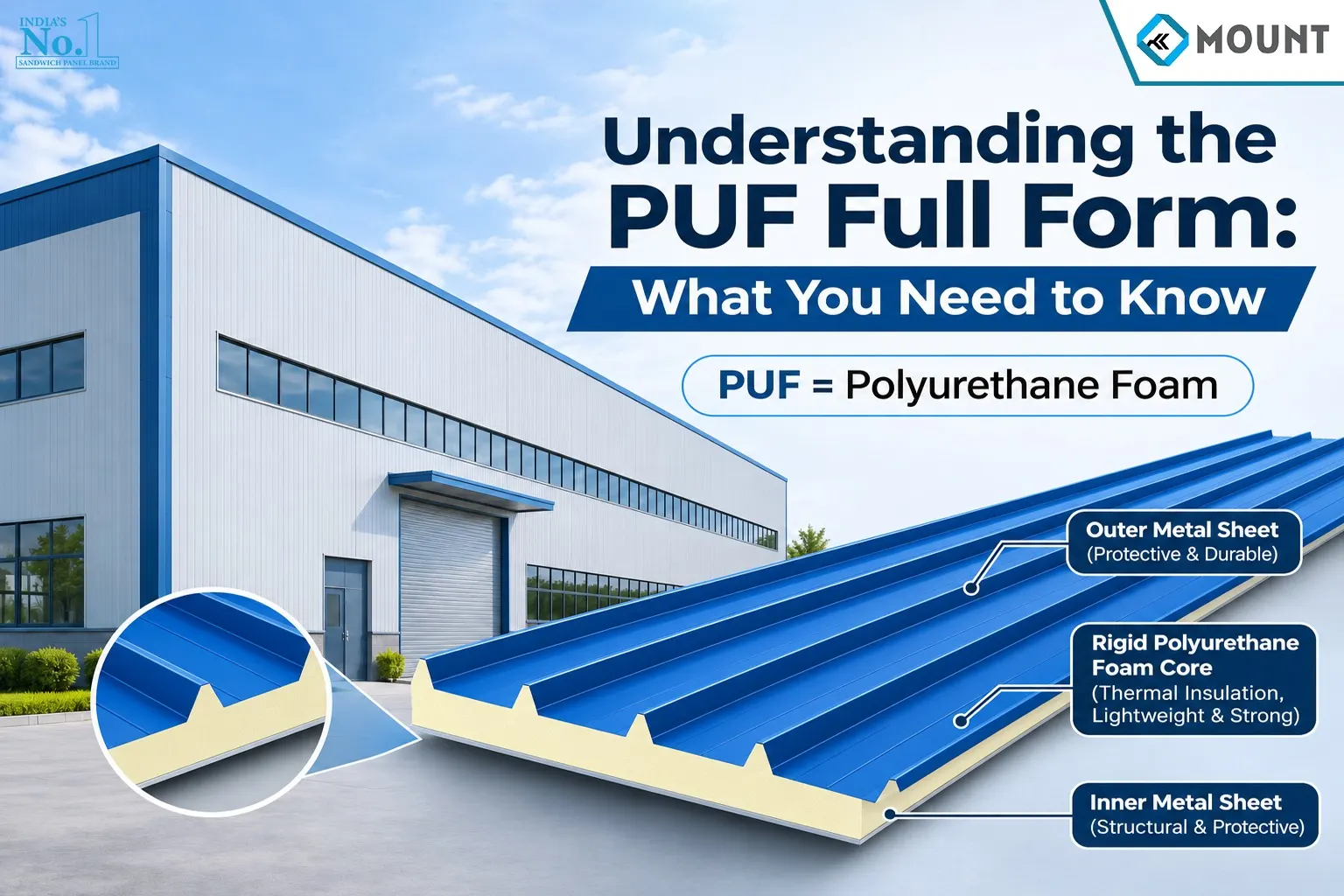
PUF stands for Polyurethane Foam, a lightweight insulation material known for its thermal insulation properties. It is commonly used as the core material in PUF sandwich panels, which combine insulation with protective outer metal sheets.
In this guide, we will explain the PUF full form, its engineering applications, material properties, advantages and different uses across industries.
What Is PUF?
PUF stands for Polyurethane Foam. It is a type of polymer foam produced through a chemical reaction involving polyols and isocyanates.
The resulting material has a cellular structure that helps reduce heat transfer, making it useful for insulation applications.
PUF is commonly used in:
- Industrial roofing systems.
- Insulated wall panels.
- Cold storage facilities.
- Refrigeration equipment.
- Commercial buildings.
- Temperature-controlled warehouses.
- Insulated doors and enclosures.
Its thermal insulation properties make it a popular choice for applications where maintaining indoor temperatures is important.
Importance of Understanding the PUF Full Form
Understanding the PUF full form helps buyers, engineers, architects and construction professionals identify the material used in different insulation products.
For example, when a manufacturer mentions a PUF panel, it generally refers to a composite panel that uses polyurethane foam as its insulation core.
Knowing the material helps buyers understand its purpose, performance characteristics and suitability for different applications.
What Is the PUF Panel Full Form?
The PUF panel full form is Polyurethane Foam Panel.
A PUF panel is an insulated sandwich panel consisting of a polyurethane foam core placed between two outer facing sheets, commonly made of coated metal.
The foam core helps reduce heat transfer, while the outer sheets provide protection and contribute to the panel’s structural performance.
PUF panels are available in different thicknesses, profiles and dimensions depending on the building’s requirements.
Usage of PUF Panels in Construction
PUF panels are widely used in modern industrial and commercial construction because they combine insulation and protective facings in a single building component.
Some common applications include:
Industrial Buildings: PUF panels can be used for insulated roofs and walls in factories and manufacturing facilities.
Warehouses: Insulated panels help reduce heat transfer through building roofs and walls.
Cold Storage Facilities: PUF panels are used in temperature-controlled environments where insulation and properly sealed joints are essential.
Food Processing Units: They can form part of insulated building enclosures designed for temperature management.
Commercial Buildings: PUF panels can be considered for roofing and wall applications where thermal insulation is required.
Explore Mount’s PUF panel solutions to understand their applications in industrial and commercial construction.
Benefits of PUF Panels
PUF panels offer several advantages when correctly selected and installed.
- Thermal Insulation
The polyurethane foam core has low thermal conductivity, helping reduce heat transfer through roofs and walls.
- Energy Efficiency
By limiting unwanted heat movement, PUF panels can help reduce the cooling requirements of suitably designed buildings.
- Lightweight Construction
PUF panels combine insulation and outer facings into one component, which can simplify building-envelope installation.
- Efficient Installation
Factory-manufactured panels are available in different dimensions and can help streamline roofing and wall installation.
- Versatile Applications
PUF panels can be used in industrial buildings, warehouses, cold storage facilities and commercial construction.
Actual performance depends on panel thickness, core properties, facing materials, joint design and installation quality.
What Is the PUF Insulation Full Form?
The PUF insulation full form is Polyurethane Foam Insulation.
It refers to the use of polyurethane foam as an insulating material to reduce heat transfer between different environments.
PUF insulation is commonly used in roofs, walls, refrigeration systems, cold storage facilities and insulated enclosures.
Role of PUF Insulation in Energy Efficiency
Insulation plays an important role in controlling heat movement through a building.
In hot climates, poorly insulated roofs and walls can allow unwanted heat to enter indoor spaces. This can increase the workload on air-conditioning systems.
PUF insulation helps reduce this heat transfer because of its low thermal conductivity.
Its contribution to energy efficiency depends on several factors:
- Insulation thickness.
- Thermal conductivity of the foam.
- Quality of panel joints.
- Air leakage through openings.
- Building orientation and exposure.
- Ventilation and HVAC performance.
When these factors are properly considered, PUF insulation can support more effective temperature management.
Common Applications of PUF Insulation
PUF insulation is used in several industries where thermal control is important.
| Industry | Application |
| Construction | Insulated roofs and walls |
| Food processing | Temperature-controlled spaces |
| Cold storage | Insulated enclosures |
| Refrigeration | Insulation for equipment |
| Warehousing | Insulated building envelopes |
| Manufacturing | Temperature management in facilities |
What Is the PUF Material Full Form?
The PUF material full form is Polyurethane Foam Material.
PUF is a polymer-based insulation material with a cellular structure. Its properties make it useful in applications requiring thermal insulation and lightweight construction.
Characteristics of PUF Material
Some important characteristics of PUF material include:
Low Thermal Conductivity: Helps reduce heat transfer and supports insulation performance.
Lightweight Structure: Provides insulation without requiring the use of several separate material layers.
Versatility: Can be manufactured in different forms for different insulation applications.
Insulation Performance: Suitable for building envelopes, refrigeration and temperature-controlled environments.
Compatibility with Panel Systems: Can be used as the insulation core in composite sandwich panels.
The actual characteristics depend on the foam formulation, density, manufacturing process and application.
PUF Material Compared with Other Insulating Materials
Different insulation materials are suitable for different building requirements. The following comparison provides a general overview.
| Material | Key characteristic | Common applications |
| PUF | Low thermal conductivity and lightweight structure | Sandwich panels and refrigeration |
| PIR | Rigid foam insulation with different fire-performance characteristics | Industrial roofs and walls |
| Rockwool | Mineral-fibre insulation with non-combustible material characteristics | Fire-conscious insulation applications |
| EPS | Lightweight expanded polystyrene insulation | Packaging and building insulation |
The right insulation material should be selected according to thermal requirements, fire safety, moisture exposure, structural design and applicable standards.
What Is the PUF Full Form in Engineering?
In engineering, PUF stands for Polyurethane Foam.
The material is used in different engineering applications because it can provide thermal insulation and can be manufactured in different forms and densities.
Applications of PUF in Engineering Projects
PUF is used in several engineering and industrial applications.
- Building and Construction Engineering
PUF is used as the insulation core in sandwich panels for industrial roofing and wall systems.
- Mechanical Engineering
Polyurethane foam is used in selected equipment and machinery applications where insulation, cushioning or sealing properties are required.
- Refrigeration Engineering
PUF insulation is commonly used in refrigeration equipment and cold storage systems to help reduce heat transfer.
- Industrial Infrastructure
PUF panels can be used in factories, warehouses and temperature-controlled buildings.
- Prefabricated Construction
Factory-manufactured PUF panels can support faster building-envelope installation in suitable prefabricated construction projects.
Innovations Involving PUF
PUF technology continues to be used in different insulation and manufacturing applications.
Some areas of development include:
- Improved foam formulations.
- Better thermal insulation performance.
- Advanced sandwich panel manufacturing.
- Improved joint and connection systems.
- More efficient manufacturing processes.
- Development of insulation solutions for specialised environments.
Material selection and product performance should always be based on verified technical specifications.
What Is the PUF Full Form in Hindi?
The PUF full form in Hindi can be explained as पॉलीयूरेथेन फोम (Polyurethane Foam).
It is an insulating foam material used to reduce heat transfer in buildings, refrigeration systems and industrial applications.
In simple Hindi, PUF ek halka insulation material hai jo building ke andar aur bahar ke temperature ke beech heat transfer ko kam karne mein madad karta hai.
Usage of PUF in Local Industries
In India, PUF materials and panels are used in several industries.
Common applications include:
- Industrial roofing and wall construction.
- Cold storage and refrigerated warehouses.
- Food processing facilities.
- Pharmaceutical buildings.
- Manufacturing plants.
- Commercial and prefabricated buildings.
As industrial construction and temperature-controlled storage requirements increase, insulated panel systems remain an important option for suitable projects.
What Is the PUF Sheet Full Form?
The PUF sheet full form is commonly understood as Polyurethane Foam Sheet.
A PUF sheet is an insulated sheet or panel that uses polyurethane foam as its core material. In construction, PUF roofing sheets generally consist of an insulation core between two metal facings.
These sheets are used where roofing systems need thermal insulation along with weather-resistant outer surfaces.
Understanding PUF Sheets
PUF sheets are available in different thicknesses, profiles and dimensions depending on the application.
They are commonly used for:
- Industrial roofing.
- Warehouse roofs.
- Factory buildings.
- Commercial structures.
- Temperature-controlled facilities.
The insulation core helps reduce heat transfer, while the metal facings provide surface protection.
For more information, explore Mount’s PUF sheet roofing solutions.
Advantages of PUF Sheets in Different Industries
PUF sheets offer several practical advantages.
Thermal Insulation: Help reduce heat transfer through the roof.
Lightweight Construction: Combine insulation and roofing facings in one component.
Installation Efficiency: Factory-manufactured sheets can simplify roof installation.
Versatile Applications: Suitable for different industrial and commercial roofing requirements.
Temperature Management: Can support more stable indoor conditions when correctly specified and installed.
The right PUF sheet should be selected according to roof design, structural requirements, weather exposure and insulation targets.
Conclusion
PUF stands for Polyurethane Foam, a widely used insulation material in modern construction and industrial applications.
From PUF panels and roofing sheets to cold storage and refrigeration systems, the material helps reduce heat transfer and supports better temperature management.
Understanding the PUF full form also helps buyers and construction professionals compare insulation products and select suitable solutions for their projects.
However, the performance of any PUF product depends on its formulation, thickness, density, facing materials and installation quality.
If you are planning an industrial or commercial building project, explore Mount’s PUF panel solutions to understand the available insulated panel options.
Frequently Asked Questions About PUF
1. What is the full form of PUF?
PUF stands for Polyurethane Foam. It is a polymer-based foam material commonly used for thermal insulation in construction, refrigeration and industrial applications.
2. What is the PUF panel full form?
PUF panel stands for Polyurethane Foam Panel. It generally refers to an insulated sandwich panel with a polyurethane foam core between two outer facing sheets.
3. What is the PUF insulation full form?
PUF insulation refers to Polyurethane Foam Insulation. It is used to reduce heat transfer in roofs, walls, refrigeration equipment and temperature-controlled spaces.
4. What is the PUF material full form?
PUF material stands for Polyurethane Foam Material. It is a lightweight polymer foam used in insulation and other industrial applications.
5. What is the PUF full form in engineering?
In engineering, PUF stands for Polyurethane Foam. It is used in construction, refrigeration, industrial insulation and selected mechanical applications.
6. What is the PUF full form in Hindi?
PUF ka full form Polyurethane Foam hai. Hindi mein ise पॉलीयूरेथेन फोम kaha jata hai. It is used as an insulation material to help reduce heat transfer.
7. What is the PUF sheet full form?
PUF sheet commonly refers to a Polyurethane Foam Sheet. In roofing applications, it generally describes an insulated sheet with a polyurethane foam core and outer metal facings.
8. What are PUF panels used for?
PUF panels are used in industrial buildings, warehouses, factories, cold storage facilities, food processing units and commercial structures for insulated roofing and wall applications.
9. Are PUF panels good for thermal insulation?
Yes. PUF panels have a low-thermal-conductivity foam core that helps reduce heat transfer. Their actual insulation performance depends on thickness, density, panel construction and installation.
10. What is the difference between PUF and PIR?
PUF generally refers to polyurethane foam, while PIR stands for polyisocyanurate. Both are related rigid foam insulation materials, but their chemical formulations and fire-performance characteristics differ.
11. What factors should be considered when buying PUF panels?
Important factors include insulation thickness, core density, thermal conductivity, metal facing material, panel dimensions, structural requirements, joint design and manufacturer specifications.
Similar Events

 14 November, 2026