 Aug 17, 2026
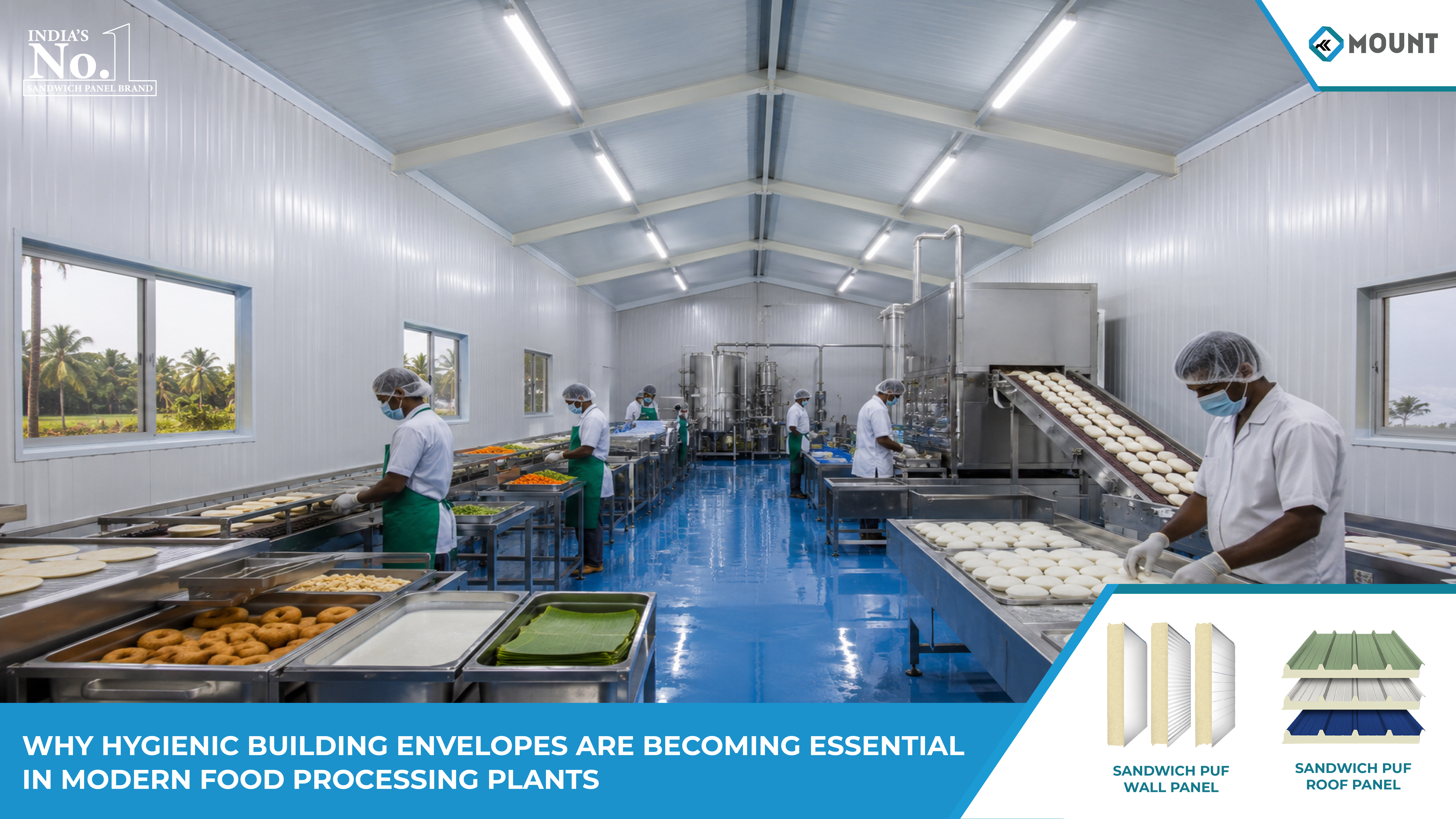
Why Hygienic Building Envelopes Are Becoming Essential in Modern Food Processing Plants
Walk into a food processing facility that has failed an audit, and the problem is rarely the machinery. It’s the wall that’s sweating condensation onto a packaging line, the ceiling joint where dust collects and won’t wipe clean, or the roof cavity where insulation has degraded enough to let ambient heat creep into a chilled zone. Food safety failures are frequently traced back not to process design but to the building envelope itself, the walls, roof, and ceiling systems that were never engineered to hold the tolerances a modern processing environment demands.
This is why hygienic wall & roof panel construction has moved from a specialist niche to a baseline expectation across dairy, beverage, packaging, and cold storage projects. The envelope isn’t just shelter anymore; it’s part of the food safety system.
What “Hygienic” Actually Means in Construction Terms
A hygienic building envelope is defined by a specific set of physical properties, not a marketing claim. Surfaces need to be smooth and non-porous, so bacteria and mould have nowhere to establish themselves. Joints between panels need to be sealed tightly enough to prevent moisture and pest ingress. And the entire assembly needs to resist the aggressive washdown cycles , often involving high pressure water, steam, and caustic cleaning agents, that processing plants run multiple times a day.
This is precisely the gap that insulated Mount PUF sandwich roof sheet and wall panel systems were designed to close. Unlike built up roofing assemblies with multiple layers, seams, and exposed fasteners that create bacterial harbourage points, a single,piece sandwich panel presents a continuous, cleanable surface from ridge to eave.
Thermal Stability and the Condensation Problem
Temperature controlled environments live or die on their ability to maintain a stable internal climate. Every degree of thermal drift forces refrigeration and HVAC systems to work harder, and every unmanaged temperature differential between the inside and outside of a wall creates the conditions for condensation. In a food plant, condensation dripping from a ceiling isn’t a cosmetic issue , it’s a direct contamination risk that auditors flag immediately.
Mount Wall & roof panel systems with a continuous polyurethane foam core address this by eliminating thermal bridging across the envelope. Because the insulation core runs uninterrupted between the metal facings, there’s no cold spot for moisture to condense against, which keeps both the structure and the product environment dry.
Panel Thickness Isn’t a Standard Number
One question that comes up in nearly every technical discussion with a food industry client is what PUF panel thickness is actually required for their application. The honest answer is that it depends on the target internal temperature, the ambient climate at the site, and the specific product being processed. A dry storage warehouse and a sub-zero cold room have entirely different insulation demands, and specifying a single thickness across a facility without evaluating each zone separately is a common and costly mistake.
Fire Safety in Insulated Envelope Design
Food processing plants often run continuous electrical loads, refrigeration compressors, and in some cases open flame processing equipment, which makes fire performance a non-negotiable part of envelope specification. This is why serious buyers evaluate fireproof panel manufacturers as carefully as they evaluate thermal performance; a panel core with poor fire behaviour can turn a contained incident into a structural emergency. Fire,rated PU and mineral,wool,core options exist specifically for zones where this risk profile demands it, and matching core type to occupancy risk is a standard part of a proper envelope specification process.
Speed of Construction Without Compromising Compliance
Food industry projects tend to run on tight commissioning timelines, particularly when a facility needs to be operational before a specific harvest or production season. Prefabricated PUF sheets and panel systems allow structural envelopes to be erected significantly faster than conventional brick,and,plaster or built-up metal construction, without sacrificing the airtightness and surface hygiene that food safety compliance demands.
Evaluating Manufacturers and Cost
When comparing a PUF sandwich roofing panel price across vendors, the number on a quotation rarely tells the full story. Core density, facing gauge, joint detailing, and fire rating all affect long-term performance, and a lower upfront price frequently correlates with a thinner core or lighter gauge facing that compromises insulation value over the panel’s service life. Buyers evaluating a PUF roofing panel manufacturer should be asking about core density and long-term thermal performance data, not just the per square metre rate.
Mount’s Role in Food Industry Infrastructure
Mount Roofing & Structures works with food processing, dairy, and cold storage clients on exactly this kind of zone,by zone envelope planning, matching panel thickness, core type, and fire rating to the actual operational profile of each space rather than applying a blanket specification across the entire facility. As one of the recognised top wall PUF panels manufacturing companies, our production process is built around consistent core density and precision panel dimensions, which keeps joint tolerances tight across large-scale installations.
If your next facility needs an envelope engineered around food safety compliance rather than retrofitted to meet it, it’s worth involving Mount at the design stage rather than after the shell is already up.
Frequently Asked Questions
Q: What core density is recommended for PUF panels in cold storage versus dry processing zones?
A: Cold storage applications typically require a higher,density PU core to maintain thermal performance at sub,zero setpoints, while dry processing and packaging zones can often use a standard density core since the temperature differential across the envelope is smaller.
Q: How are panel joints detailed to prevent bacterial harbourage in food grade facilities?
A: Tongue,and,groove or camlock joint systems with sealant application at the panel interface are used to eliminate exposed seams, and internal corner and floor junctions are typically coved or sealed to remove the sharp right angles where residue and moisture would otherwise collect.
Q: Does panel core type affect fire rating in occupied processing environments?
A: Yes, standard PU foam cores behave differently under fire exposure than fire retardant PU or mineral wool cores, and facilities with continuous electrical loads or higher occupancy density should specify core type based on the applicable fire safety classification for that occupancy.
Q: How is PUF panel thickness calculated for a specific internal temperature setpoint?
A: Thickness is determined through a thermal transmittance (U,value) calculation that accounts for the target internal temperature, external ambient conditions, and the panel’s core conductivity, rather than being selected from a generic thickness chart.
Q: What factors, beyond price per square metre, should be compared when evaluating PUF panel quotations?
A: Facing steel gauge and coating specification, core density, joint system design, and documented fire rating all affect long term performance and should be compared alongside price, since panels with similar quoted rates can differ significantly in service life and insulation retention.
Similar Events
 23 October, 2026