 Jul 29, 2026
Why Managing 10 Different Vendors Is Costing Your Project More Than You Think
At the planning stage, managing multiple vendors rarely feels like a problem.
One supplier handles the steel structure, another supplies roofing sheets, A third manages insulated panels, Someone else provides fasteners and another company handles skylights.
On paper, everything looks organised.
Then execution begins. Suddenly, project review meetings become filled with questions.
- Why haven’t the panels arrived yet?
- Who is responsible for the revised drawings?
- Why is the roofing contractor waiting for accessories?
- Which supplier is handling the compatibility issue between the wall system and the structure?
Most project delays don’t originate from a single major problem.They emerge from dozens of small coordination gaps between different vendors and those gaps are often far more expensive than people realize.
Procurement Looks Cheaper Than It Actually Is
Many procurement teams focus on obtaining the lowest possible price from individual suppliers.
That approach appears logical.
If every package is sourced separately, there should be greater cost control.
In reality, industrial projects rarely operate that neatly.
Every supplier has different production schedules, approval processes, delivery timelines, technical teams, and communication channels.
Managing those moving parts requires time.
Project managers spend additional hours coordinating vendors. Procurement teams handle multiple follow-ups. Site teams wait for missing components. Consultants resolve avoidable coordination issues.
None of these costs appear in a material quotation.
They still affect the project budget.
Delays Rarely Come From Materials Alone
A roofing system is not simply roofing sheets.
It depends on structural readiness.
Fastener availability.
Accessory compatibility.
Drawing approvals.
Installation sequencing.
When different suppliers are involved, even a small delay can affect multiple downstream activities.
A panel supplier waiting for structural dimensions creates a delay for installation teams. Roofing work may be postponed while other contractors adjust schedules.
The result is something every project manager has experienced.
One delay becomes three.
Three delays become ten.
The project timeline starts moving in the wrong direction.
Accountability Becomes Complicated
One of the least discussed challenges in multi-vendor projects is accountability.
Imagine a leakage issue appears after installation.
The roofing supplier points toward the fasteners.
The fastener supplier points toward installation practices.
The installation contractor references the panel detailing.
The panel supplier cites structural alignment.
At this point, solving the issue becomes secondary.
Determining responsibility becomes the primary challenge.
Projects operate far more efficiently when there is a clear line of accountability across major building systems.
That clarity often disappears when too many independent suppliers are involved.
Technical Compatibility Is Often Overlooked
Modern industrial buildings are far more integrated than they used to be.
Structural systems, insulation solutions, roofing assemblies, wall panels, skylights, and fastening systems must function together as a complete envelope.
The challenge is that products sourced from different suppliers are not always designed with one another in mind.
A project team may select Sandwich puf panels from one manufacturer and accessories from another, only to discover installation complexities later.
The same issue can emerge with structural systems, roofing details, and fastening specifications.
What appears compatible on a datasheet does not always translate into seamless execution on site.
The Hidden Cost of Quality Inconsistency
Another challenge with fragmented sourcing is quality variation.
Even when every supplier meets minimum specifications, manufacturing standards, tolerances, coatings, and engineering approaches can differ.
The consequences are often subtle.
Installation takes longer.
Alignment issues emerge.
Additional modifications become necessary.
Site teams spend more time resolving details that could have been addressed during manufacturing.
For projects operating under strict timelines, these inefficiencies can become surprisingly expensive.
Why Integrated Procurement Is Becoming More Common
Across warehouses, manufacturing facilities, cold storage projects, logistics parks, and data centers, developers are increasingly moving toward integrated sourcing models.
The reason isn’t convenience alone.
It’s predictability.
Working with a single partner simplifies communication, streamlines approvals, reduces procurement complexity, and improves project coordination.
When major building systems are supplied through one source, project teams spend less time managing interfaces and more time moving the project forward.
That difference becomes particularly important in large-scale industrial developments where timelines directly affect business operations.
Building Systems Work Better When They Are Planned Together
Consider a modern industrial facility.
The structure supports the roof.
The roof interacts with insulation systems.
Wall panels connect with structural members.
Fasteners influence weather performance.
Daylighting solutions integrate with roofing layouts.
Every component affects another.
This is why developers increasingly prefer working with a Peb Construction Company capable of supporting multiple aspects of the building envelope rather than sourcing each component independently.
The objective is not simply reducing the number of purchase orders.
It is reducing project complexity.
Why the Industry Is Moving Toward End-to-End Partners
Industrial construction has evolved.
- Project expectations are higher.
- Timelines are shorter.
- Performance requirements are more demanding.
As a result, developers increasingly seek partners capable of delivering complete solutions rather than individual products.
A project requiring cold room panels, Fire Rated Roof Panels, insulated wall systems, daylighting products, roofing solutions, and fastening systems benefits significantly when these elements are planned within a coordinated framework.The value comes from integration as much as from the products themselves.
Why Businesses Choose Mount
Mount Roofing & Structures has built its capabilities around a simple reality.Industrial projects function better when major building systems are engineered and supplied through a coordinated approach.
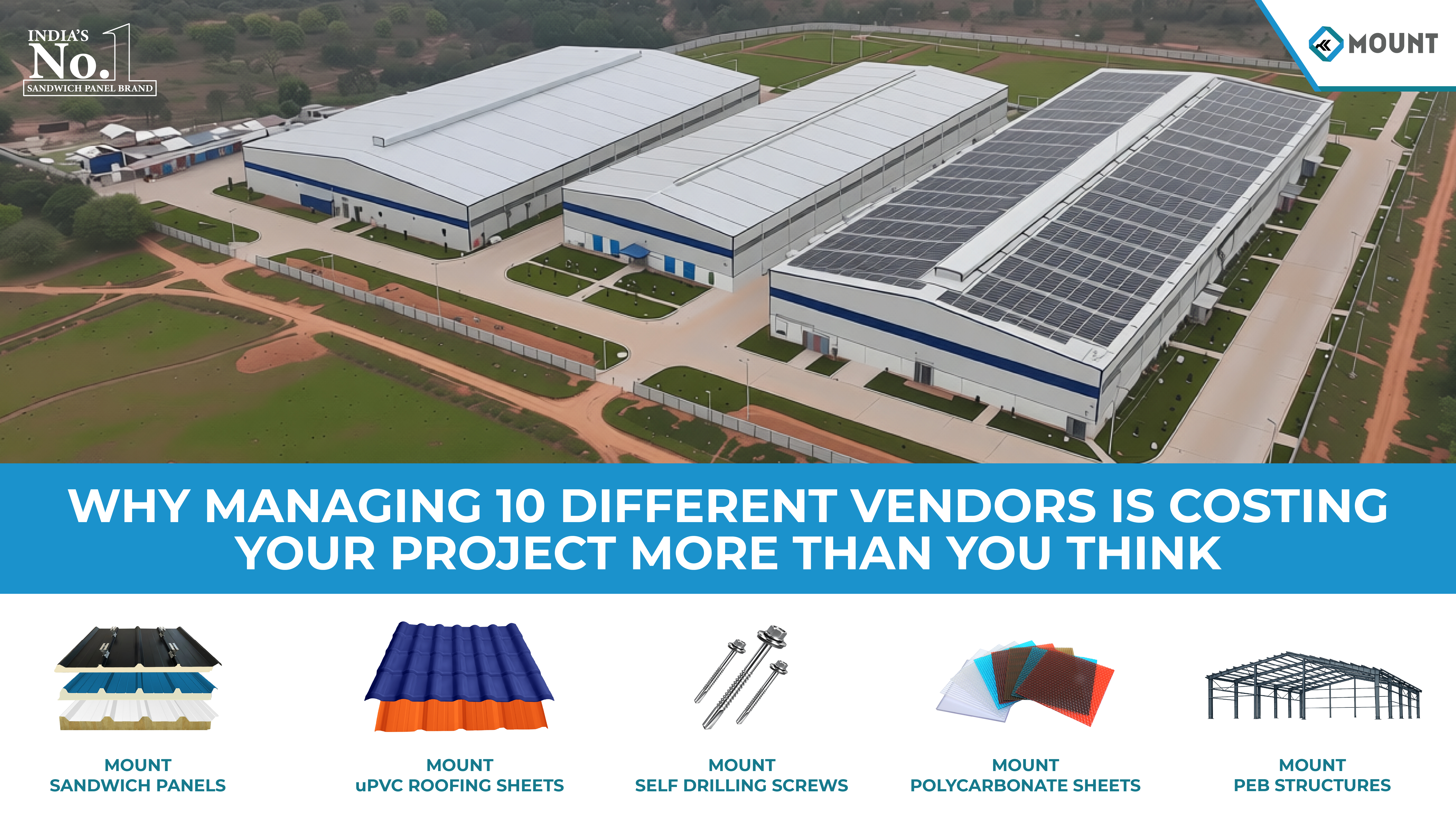
Instead of managing separate suppliers for structures, roofing, insulation, walling, daylighting, and fastening systems, developers can access a comprehensive portfolio under one roof.
From PEB solutions and insulated panel systems to heat resistant uPVC roofing sheets, fastening systems, and products from an experienced polycarbonate sheets manufacturer, Mount helps simplify procurement while improving coordination across the project lifecycle.
As a trusted Rockwool sandwich panel manufacturer and integrated infrastructure partner, Mount supports faster execution, consistent quality, and greater accountability from design through delivery.Because the real cost of managing ten vendors is rarely found in the quotation.
It’s found in the delays, coordination challenges, communication gaps, and inefficiencies that follow and those costs add up faster than most project teams expect.
FAQs
1. Why do multi-vendor projects often experience delays?
Different suppliers operate on separate production schedules, approval processes, and delivery timelines, creating coordination challenges that can affect project sequencing.
2. How does integrated sourcing improve project execution?
Integrated sourcing reduces communication gaps, simplifies procurement, improves coordination, and helps maintain consistency across building systems.
3. What risks are associated with sourcing building components from multiple suppliers?
Common risks include compatibility issues, accountability challenges, quality inconsistencies, scheduling conflicts, and increased project management complexity.
4. Why is accountability important in industrial construction projects?
When issues arise, clear accountability allows faster problem resolution and reduces disputes between suppliers, contractors, and project stakeholders.
5. What advantages does a single solutions provider offer?
A single provider can streamline procurement, coordinate building systems more effectively, improve quality consistency, reduce project complexity, and support faster project delivery.
Similar Events